

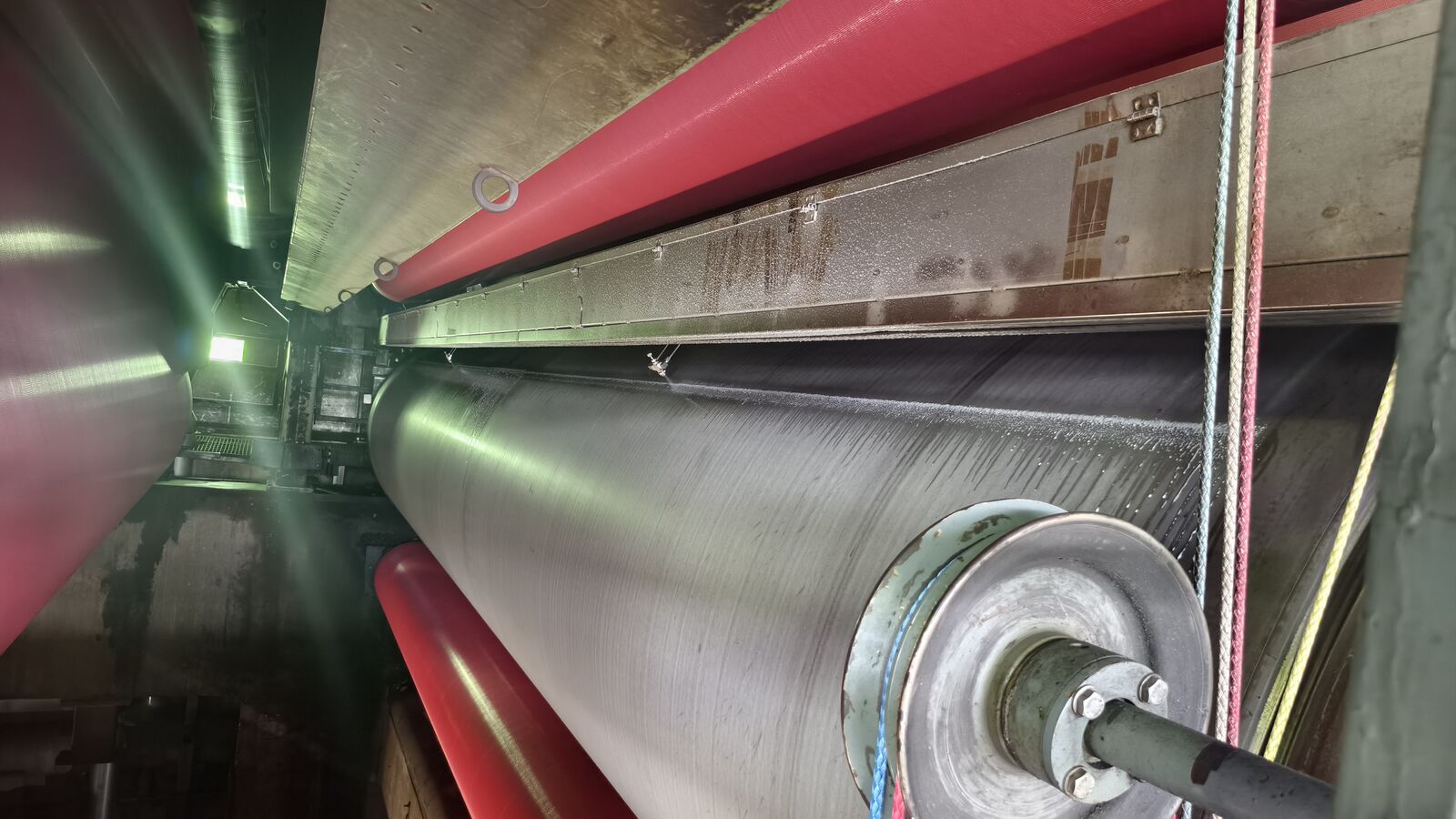
Controlled cylinder-surface treatment
Dryer Cylinder Release Agent Spray System
Apply a uniform release-agent film across the required cylinder area while coordinating spray timing with paper-machine operation.
Control adhesion and deposits at the dryer section
Deposit buildup on a paper machine dryer cylinder can disturb sheet release, increase doctor-blade loading, and force cleaning interruptions. The operating symptoms may be visible at the cylinder, but the right response depends on the contaminant, furnish, chemical program, temperature, machine speed, and where the material first begins to accumulate.
Baozt engineers a traversing release agent spray system for suitable cylinder applications. The system meters chemical delivery, uses air-assisted secondary atomization, and moves the nozzle through an adjustable range. This creates a more repeatable process than hand spraying or an uncontrolled fixed spray.
Fine atomization with controlled movement
The nozzle is designed to atomize the release agent internally before the spray reaches the target. An air-barrier design helps direct the pattern and limit chemical drift under surrounding airflow. The traversing mechanism spreads application across the selected width, while adjustable travel limits keep the nozzle within the intended process zone.
Liquid delivery and motion are linked. If the traverse stops or the system receives a stop condition, the controller can stop the metering pump to prevent fixed-point application and chemical waste.
From site survey to stable operation
Assess
Review process symptoms, dimensions, utilities, chemical properties, and automation signals.
Engineer
Define brackets, active range, nozzle count, tubing route, cabinet location, and control philosophy.
Install
Mount and align the system with safe access for operation, calibration, and maintenance.
Commission
Set flow, atomizing pressure, travel speed, limits, alarms, and machine interlocks.
Built for restricted, high-temperature areas
Dryer-cylinder mounting space is often narrow and unique to the machine. Baozt uses field measurements to design installation brackets rather than forcing a generic support arrangement. Stainless-steel construction and high-temperature tubing support operation in hot, humid conditions, while the withdrawable main assembly improves maintenance access.
Common inspection points include the nozzle, cable chain, limit switches, relay components, and air and liquid tubing. Keeping critical spares on site helps mills restore normal operation quickly.
Measure process results
Before commissioning, record the current cleaning interval, deposit condition, sheet-break pattern, doctor-blade condition, and release-agent consumption. After optimization, compare the same measures over a representative production period. This provides a useful basis for decisions and avoids relying on unsupported performance claims.
During tuning, change one major variable at a time where production permits. Record liquid flow, air pressure, traverse speed, active width, paper grade, and any unusual machine event. A controlled log makes later troubleshooting faster and gives the mill a repeatable starting point after maintenance.
For broader process guidance, review Baozt’s paper machine contamination-control approach.
Frequently asked questions
Where is the spray beam installed?
The mounting position is selected after a site survey. Dryer-cylinder installations normally require custom brackets because available space, access, heat, and surrounding structures differ by machine.
How does the system limit release agent waste?
An electromagnetic metering pump controls liquid delivery while secondary atomization produces a fine spray. PLC interlocks stop chemical delivery when the traverse is stopped or the process signal requires a pause.
Can the spray width be adjusted?
Yes. Travel limits can be positioned to match the required application range, and one, two, or three-nozzle configurations are available for different widths and operating conditions.
What information is needed for a proposal?
Useful inputs include machine width and speed, application location, photos and dimensions, deposit type, existing release agent, available compressed air, control voltage, and required DCS signals.
Get a configuration for your dryer section
Share clear photos, a dimensioned sketch, operating conditions, and the problem history. Our engineers will identify the next practical step.